
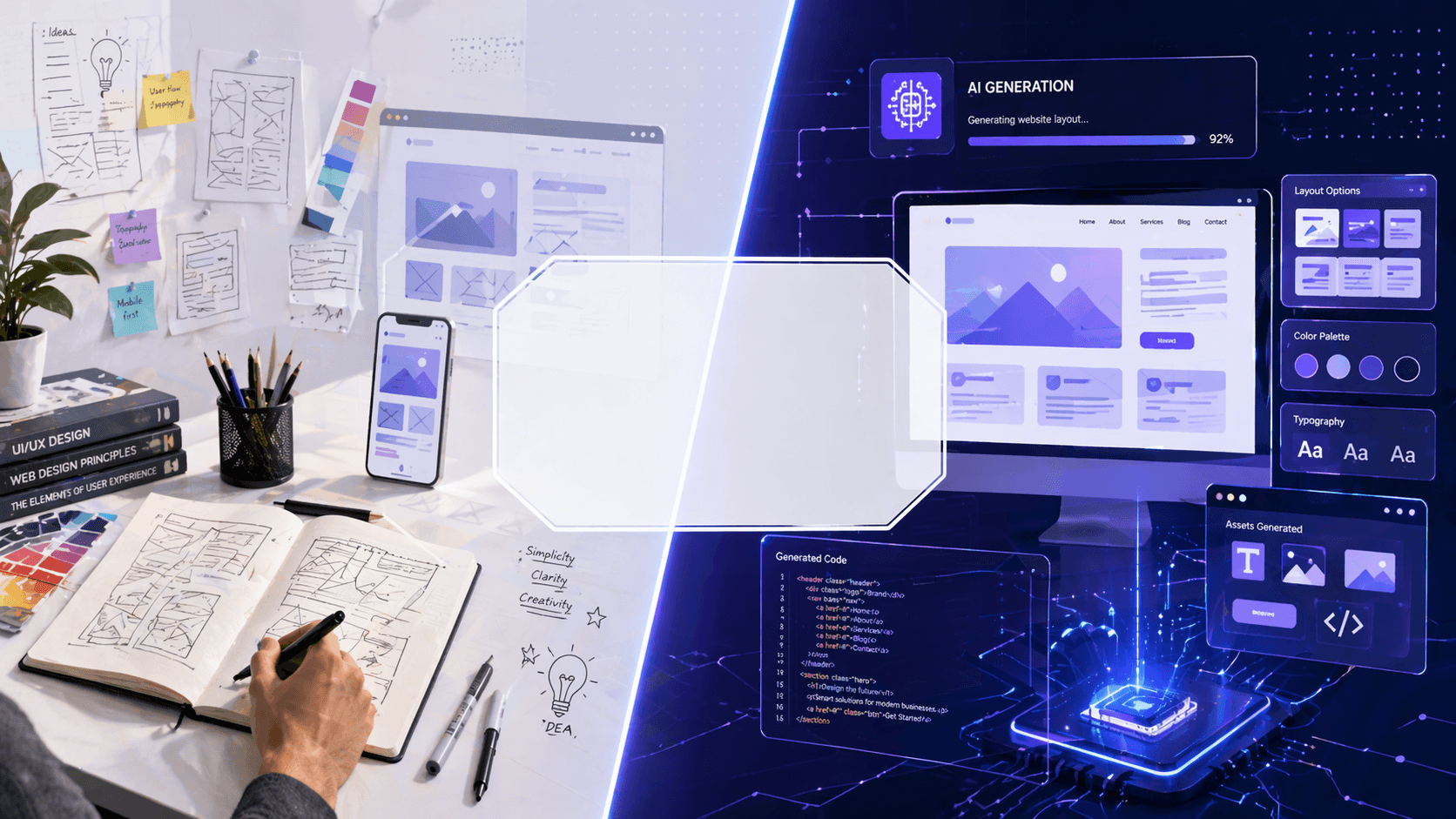
The connection between AI and web design is no longer a future concept. It has begun reshaping the ways businesses operate, products are built, and digital experiences are delivered.
According to the IMF, it is expected that AI will impact almost 40% of the jobs worldwide. And web design is a part of that shift. From AI-generated layouts to automated coding and content creation, the way websites are designed and built is changing quickly.
The real question is whether AI is changing web design? Will AI replace web designers reddit or simply change what good design looks like?
What AI Can Do in Web Design Today
AI has introduced a new layer of speed and automation in the design process. In the past, the tasks that took hours and days to complete can now be done in minutes. This can be evident across a wide range of tools and platforms.
- An AI-free website builder generates full sites quickly.
- There are various design tools that analyze layouts and suggest improvements.
- Similarly, there are AI tools that automate repetitive editing tasks across images and videos.
- Most of the generative tools are used for content creation.
So there is no doubt that these tools are improving efficiency. They reduce manual work, speed up production, and lower the barriers to creating websites. But faster is not always better.
Limitations of AI in Web Design
AI can generate a website, but this does not mean that it can design one properly. Most of the AI builders rely on patterns, templates, and existing data. This means the output often feels the same, predictable, and difficult to differentiate.
1: Creativity
AI can mix patterns and suggest ideas, but it cannot create them with real feeling or purpose. It lacks the ability to fully understand a brand’s personality, audience emotions, and the story behind the design. This is one of the reasons AI often produces safe, similar-looking results rather than original work.
2: UX
Another ability of AI is to build layouts quickly, but it does not understand what real people think and behave on a website. It might miss out small details that can affect trust, comfort, and ease of use.
The good user experience us depend on human judgment, testing, and a clear understanding of user needs.
3: Customization
Although AI tools can make websites fast, they often follow fixed templates and common pattern-based strategies.
They lack the ability to capture unique brand needs, specific features, and business goals. Whereas human designers can shape details. This makes the website feel personal and fits the brand naturally.
AI and Web Design: Can AI Replace Human Creativity?
| Area | Human Creativity | AI Automation | Where Humans Do Better |
| Idea Creation | The ideas are created based on emotions, experience, and brand goals. | Most of the ideas are dependent on patterns and existing data. | Humans are better at making ideas feel original, meaningful, and connected to the brand. |
| Design Style | Designers often choose a style that matches the company’s voice, audience, and personality. | Often suggest common styles that look clean but may feel generic. | Humans are better at creating a unique look than at producing template-like results. |
| User Understanding | Humans know how real people feel, scroll, click, and react on a website. | AI predicts patterns, but misses real user behavior in context. | Humans can build better websites that feel natural and easy to use. |
| Problem-Solving | Designers can adjust ideas if something does not work for businesses and the audience. | Following a set of patterns cannot solve unusual design problems. | Humans are stronger when the project needs flexible thinking and smart decisions. |
| Brand Storytelling | Ability to turn a brand’s story into a design that feels personal and emotional. | Content and visuals are generated but lack a strong brand feel. | Humans are better at making the website feel authentic and memorable. |
| Customization | They can shape every detail to fit specific needs, goals, and preferences. | Works best with standard layout and fixed options. | Humans can do better when a website needs a custom, one-of-a-kind approach. |
Moving forward the graph below also presents a broader comparison of how humans and AI perform across different aspects of design and decision-making. While the table above focuses more on human strengths in creative and strategic work, this visualization shows a more balanced view across multiple performance metrics.
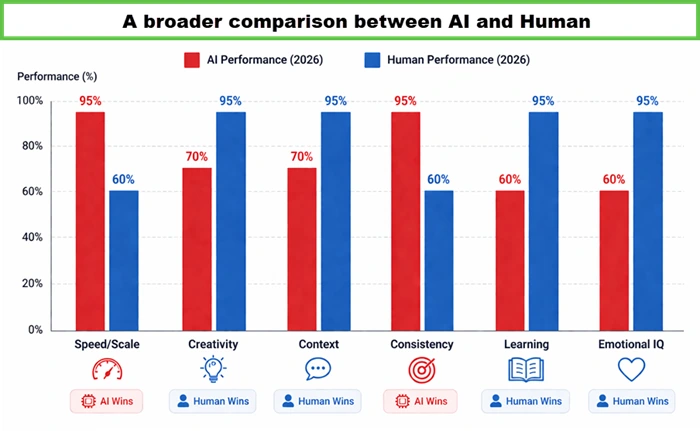
Together, they highlight that the advantage depends on the task , some areas favor human creativity and judgment, while others lean toward AI efficiency and scale.
Role of Web Designers in the AI Era
Web designers are not disappearing in the era of AI. Their role has become stronger with some changes. The best are those who are learning to work with the change. They understand the link between AI and web design, benefit from its power without losing their unique touch.
1: Used for repetitive tasks, not for creative decisions
Designers are using AI for repetitive tasks. It excels at automating time-consuming, repetitive tasks, allowing humans to focus on high-level creative and strategic work.
Designers allow it to handle repetitive, uncreative tasks like resizing images, color correction, layout suggestions, and accessibility checks. Designers focus more on branding, storytelling, and UX strategy.
2: AI generates an idea, but the designer designs
Designers are using AI for inspiration, not execution. They help to generate ideas, but they won’t replace the designers’ visions. Designers brainstorm ideas and customize and refine the final design themselves.
There are various beginners who are enrolling in any AI and web design course to get full knowledge of its use.
3: Balancing AI automation with human emotions
No doubt AI makes recommendations, but they lack human emotions and cannot grasp brand storytelling. Therefore, designers are using AI for efficiency, but ensure that the final design has soul, imagination, and personality.
Should Businesses Rely Only on AI?
No, businesses should not solely rely on AI tools. AI helps with speed, basic layout, and simple content, but cannot fully replace human thinking.
People are important to guide creativity, shape the strategy, and make the website feel unique to the brand. The best result is possible with the right balance, where AI works on handling repetitive tasks, and humans make important decisions.
This combination not only saves time but also keeps the design thoughtful, personal, and useful for real users.
Final Verdict: Replacement or Collaboration?
The connection between AI and web design is deeply rooted. Rather than fearing AI, web designers should add it as a collaborative partner. AI is never here to replace designers. But it is to enhance creativity, efficiency, and accessibility.
The future of the best web designers is not the one who rejects AI, but the ones who use it to enhance their creativity and efficiency. Remember, AI is a tool, not a replacement.
FAQs
1: Is web design over?
No, the scope of web design is still alive. It has simply changed as AI has made tasks faster, and businesses still need people to create meaningful and brand-focused websites.
2: Will AI replace graphic designers?
AI can never fully replace graphic designers. It is helping them with quick designs and ideas.
3: Can I rely on AI for my website?
Yes, AI is a helpful tool, but you must not fully rely on it. It will work best when combined with human input and AI, producing websites that feel professional, personal, and effective.
4: How can designers benefit from AI tools in the digital era?
They can enroll themselves in an AI and web design course and learn its use so they can keep up with the trend.
5: Is web design cheaper with AI tools?
With the help of tools, the time and effort are reduced. This lowers the costs for some projects.